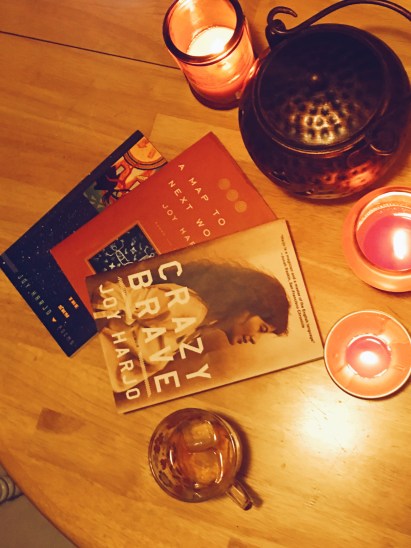
Crazy Brave: A Memoir by Joy Harjo

Processed with VSCO with a5 preset

4.0 Stars

Joy Harjo is a Mvskoke poet, musician and activist. She is a strong defender of women’s equality and is an active member of the Muscogee tribe. She uses her poetry as a “voice of the indigenous people.” I first encountered Harjo through her poetry and I’ve been hooked ever since. Harjo’s works blend the physical world with the spiritual world. She is almost a mystic, a shaman, a seer. In both her memoir and her poetry she speaks of visions and stories as though they are a part of her life and the spirits of her ancestors.

Harjo’s memoir chronicles her life from before she was born, to when she was fighting in the womb and had to be pulled into this world, to how she finally was able to envision herself above panic and poverty and eventually follow the spirit of poetry. Her storytelling in enchanting and brutally honest. The lesson that Harjo lived and relived is that through the casual abuse, rape, negligence, and fear there is still the ability to transcend beyond that, to let yourself be healed, and to bring healing to others.

While most Native literature is suffused with magical realism (for lack of a better term), Harjo is one of the few who actively sees visions. While other authors create characters like the wise grandmother or the magical elder in their works, Harjo is that character. She is the one who sees into the past of her ancestors. She’s the one who relives the life of her great-grandfather through a vision. As a reader, it is not hard to suspend my disbelief; because I want to believe. I am fascinated by the idea of being able to dream the life of your great-grandmother. I am enthralled at the thought of having sickness being eaten away by an alligator in a dream. I find it mystical and wonderful. Can I honestly say that I believe it without a doubt? Probably not. However, I want to believe; and I think it is the believing that makes it beautiful.

I’ve chosen to pair this with Black Grouse, a smokey-sweet whiskey that finishes with hints of peat and a gentle smokiness. Throughout her childhood, Harjo lived in Oklahoma and everybody seemed to have smoked. She also believed that “all of these plant medicines, like whiskey, tequila, and tobacco, are potential healers. There’s a reason they’re called spirits. You must use them carefully. They open you up. If you abuse them, they can tear holes in your protective, spiritual covering.” So pour yourself a finger of whiskey, light a cigarette and enjoy this memoir.

Memorable quotes:

“In the end, we must each tend to our own gulfs of sadness, the others can assist us with kindness, food, good words, and music.”

“I felt the presence of the sacred, a force as real and apparent as anything else in the world, present and alive, as if it were breathing. I wanted to catch hold, to remember and never forget. But the current hard reality reasserted itself. I had to have the house cleaned just right or my stepfather would punish me. So I continued on my path to forgetfulness.”

Format: Paperback.

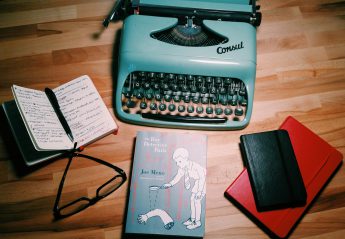
André Brink’s A Dry White Season

IMG_20160826_180728

2.5 Stars

While I enjoyed reading this book, I find myself highly judgmental of the protagonist. He is a white male living in South Africa who has never really understood the racial injustices faced by his black acquaintances until a series of events happens to a black man he knows. He has been content to enjoy his privilege and status as a white man in South Africa.

Now, to be fair, this book and the voice of the character in this book are directed to white people in South Africa who do nothing about the injustices that were going on. As a woman of color, I have had to accept the role of whites “leading the way.” I’ve had to accept how because of white feminists, we are able to have colored feminists. Somebody has to pave that road. Granted, it would’ve been great to be included from the beginning. This is a more complex issue that I won’t delve too deeply into with this review. I feel as though it is the same situation in this novel. I, personally, would prefer to hear the story from the black perspective. I would like the agency and the authority to be coming from the person who the racist injustice is acted upon, instead of that of the white savior. However, that is not the purpose of this novel. And that’s OK (I guess). It is still a very interesting read. It makes a statement for justice. It denounces the acts of violence and corruption that went on in South Africa; and it did it in a white voice for a white audience, to give them perspective and to hold them accountable.

Perhaps my biggest pet peeve with this novel was the “Affair.” The protagonist – a good, honest, church-going, exemplary white man – cheats on his wife at the end of the novel, but we knew that was coming. What really annoyed the shit out of me, was how the affair went down. The day before he fucked the new, younger chick, he fucked his old wife. And he was struck by how he was so shocked to see how old she had become. How after 30 years of marriage, her skin with wrinkled, her breasts were sagging, there with a mixture of revulsion and arousal…ugh… I’m sure his hairy balls weren’t dragging between his thighs. I was so glad that I already knew that this motherfucker dies at the end. (FYI, I’m the type of girl who still hates Robert Lowell for The Dolphin).

My judgmental critique on the protagonist aside, this novel does bring to light racial injustice. It highlights one of the most important relationships, that between a parent and their child. A child represents hope for the future. What happens in the black community when children are shot and killed and jailed? These are questions that in our modern, American society we are still facing. We have seen it in Ferguson, and Baltimore, and Milwaukee, and all over the United States. The questions and the struggle for racial equality and racial justice are real and relevant to not only our American society but a global society. The Impact in the black community in regards to over-policing and racial profiling and racial stereotypes are disregarded by the more privileged of our society. A Dry White Season does an excellent job of highlighting this and showing how it’s not just a problem of a few racists in power. What we fight against when we fight against racial injustice is something far greater. For the protagonist, he comes to this conclusion toward the end of the novel:

“today I realize that this is the worst of all: that I can no longer single out my enemy and give him a name. I can’t challenge him to a duel. What is set up against me is not a man, not even a group of people, but a thing, something, a vague amorphous something, an invisible ubiquitous power that inspects my mail and taps my telephone and indoctrinates my colleagues and incited the pupils against me and cuts up the tires of my car and paints signs on my door and fires shots into my home and sends me bombs in the mail, a power that follows me wherever I go, day and night, day and night, frustrating me, intimidating me, playing with me according to rules devised and whimsically changed by itself.”

We face almost the same enemy in American culture, except that instead of wiretapping phones and slashed tires; we have indoctrination through white pride, racial stereotyping, inadequate representation, redlining and an eschewing of history to favor the white male.

Memorable Quotes:

“My time and your time is passing…but the time of our children is still coming. And if they start killing our children, then what was it that we lived for?”

” ‘One always reads about this sort of thing,’ he said absently. ‘One hears so many things. But it remains apart of a totally different world really. One never expects it to happen to someone you actually know.’ ”

“But if you were given a choice, Colonel: wouldn’t you rather be a white child in this country than a black one?”

“You’re white. ” as if that summarized everything. “Hope comes easy to you”.

I’m pairing this book with Einstok‘s Icelandic Toasted Porter. This is one of my favorite beers. It has a nice toasted malt taste and a medium-bodied mouthfeel. It balances the caramel and coffee flavors well, making it a pleasant brew for almost any book.

Format: Paperback.

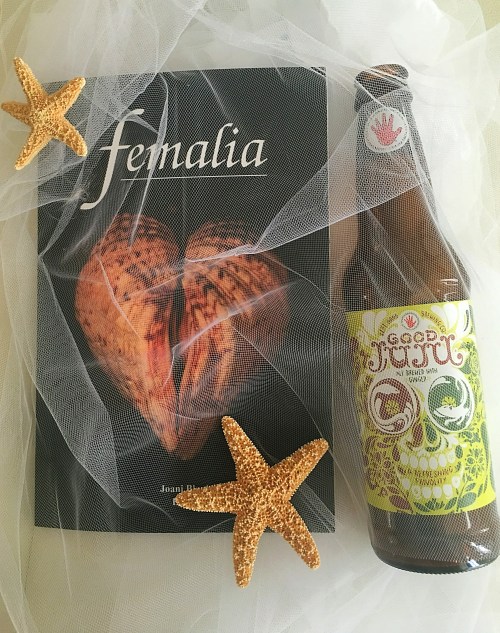
Joani Blank’s Femalia

IMG_20160821_114648

3.5 Stars

I came across Femalia by Joani Blank while reading CUNT by Musico. Feminists have been advocating this book for men and women for years to help shape people’s perspectives about their own bodies and the bodies of their partners. Femalia consists of 50 photographs of the female vulva. The purpose of this book is to show males and females that the vulva comes in many different variations and they are each perfectly formed. Sadly, some women are uncomfortable with their ladybits and worry that it doesn’t “look right.” But where do we get our expectations of what a vulva should look like? Porn? Male-dominated conversations and opinions? Women body-shaming each other? I’m sure there’s another book out there that discusses these points. However, Femalia‘s only goal lies in the photographs. There is no denying that each woman is unique and it is the hope of Blank that when men and women view these photographs they will be more comfortable with their own bodies and the bodies of their partners.

I decided to purchase this book solely on the recommendations I came across while reading feminist texts. Truthfully, the only vulva I’m intimately acquainted with is my own. There are also depictions in pornography, but we know some of those women get labiaplasty surgery to make their vulva more “acceptable.” Hearing all of this is disconcerting, especially when (as far as being a straight woman is concerned) I consider my own to be “normal” but it’s also all I know. Taking that into consideration, I decided to purchase this book and I have to agree with my fellow feminists and concur that all women should know the many different shapes and colors and variations of other women’s bodies. This way, when we hear people shaming or criticizing their own bodies or the bodies of others, we can present them with the facts. After all, if all female bodies have it, how can it be “unfeminine,” or “ugly,” or “not right looking.” We live in a society where a mom tweets a picture of sandwiches to compare her daughters “vaginas” to that of Taylor Swift. Someone never told that woman that vaginas (and by vaginas, I mean vulvas) don’t work that way. Hopefully, someone will inform her daughters. (Check out the tweet HERE and read the comments for a good laugh.)

If this review teaches you anything, it’s that the outside ladybits is the vulva; and the inside is the vagina. I never cared enough to make the distinction since “vagina” is our society’s default word for lady parts, but Blank’s book has made me change my mind, and I hope to change all of your minds! If we cannot correctly name and label our bodies, how do we protect and love ourselves, thus teaching our partners to do the same? Language holds power over us. It gives us agency and allows us to empower ourselves. Let’s not take for granted that empowered women empower women.

I’m pairing this book with Good JuJu by Left Hand Brewery because all vulvas are good juju. This beer has a crisp, fresh hint of ginger that is refreshing and light.

Format: Paperback.